
On this page
Fuel Starvation At High Revs
The engine idles and cruises fine, then falls flat or cuts when you ask for full power. Fuel demand rises with load, so a restriction that goes unnoticed at low flow becomes decisive at high flow.
Is it safe to keep going?
At reduced revs, usually. But an engine that cuts out under load is an engine that can cut out entering a bar or a marina, which is where you least want it.
Likely causes, ranked
| Cause | How common | Confirms it | Cost |
|---|---|---|---|
| Blocked primary or secondary filter | Very common | Vacuum gauge rising; filter bowl | Filters |
| Blocked tank vent | Common | Opening the filler cap restores power | Free |
| Air leak on the suction side | Common | Perished bowl seal, loose fitting | Cheap |
| Collapsing suction hose | Common | Soft hose; only fails at high demand | Hose |
| Blocked tank pickup or strainer | Common | Sludge at the pickup | Tank clean |
| Failing lift pump | Occasional | Low supply pressure | Pump |
| Sludge stirred up in a seaway | Common | Only happens when rough | Tank clean |
| Injection pump wear | Less common | Bench test | Specialist |
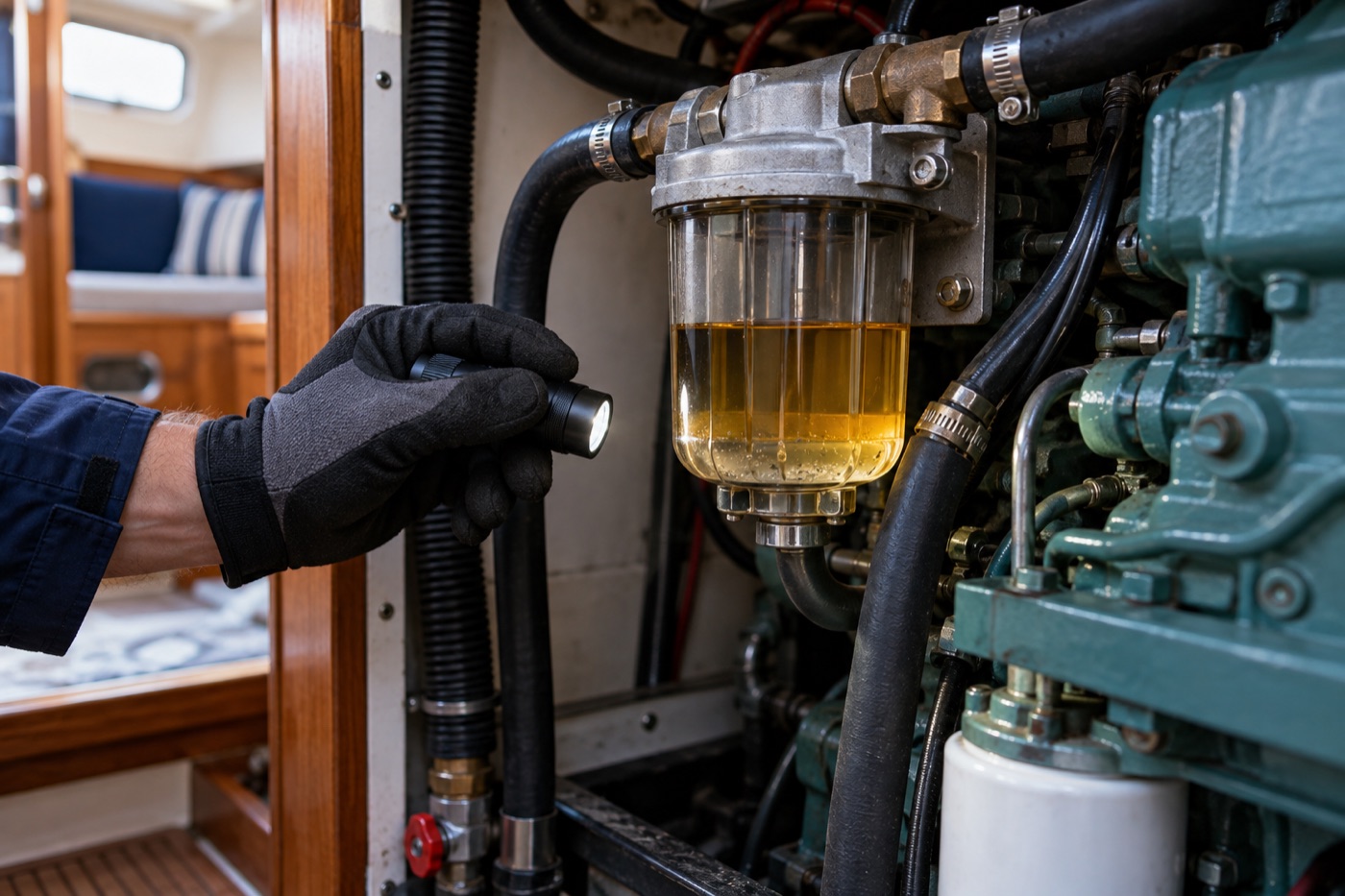
Test the vent first, because it is free. If the engine recovers when you open the fuel filler cap, the tank has been pulling a vacuum. That is a blocked or submerged vent, and it costs nothing to confirm.
Loses power under load · Fuel filters keep blocking
A vacuum gauge is worth fitting
A vacuum gauge on the primary filter shows how hard the engine is having to suck. A rising reading warns you days before a filter blocks completely, and it distinguishes a filter problem from an air leak or a pump problem instantly.
It is inexpensive and it is the single most useful instrument you can add to a marine fuel system.
What you can check yourself
- Open the fuel filler cap while it is struggling
- Filter condition, and vacuum gauge reading if fitted
- Squeeze the suction hoses — soft ones collapse under vacuum
- Separator bowl seal and every fitting on the suction side
- Whether it only happens in rough water — that points at the tank
When to call a mechanic
If filters, vent and air leaks are ruled out. Beyond those you are into the lift pump, the tank pickup and the injection pump.
Fuel filter and water separator service · Marine fuel pump repair
What marine engine work costs in Australia
Common on these engines
Tank-side rather than engine-side, so it affects every brand equally.
Fuel polishing and tank cleaning
Frequently asked questions
It runs fine until I open the throttle — why? Fuel demand rises with load. A restriction invisible at cruise becomes the limiting factor at full power.
The engine recovers if I open the fuel cap — what is that? A blocked tank vent creating a vacuum. Free to confirm, cheap to fix.
Only in rough weather — why? Motion suspends settled sludge and sends it to the filters.
Is it the injectors? Rarely on this symptom. Injectors produce rough running and smoke, not clean starvation under load.
Practical summary
Use this fault guide safely
Stop now
Shut down for oil-pressure alarms, overheating, fuel spray, smoke in the engine space or loss of cooling-water flow.
Check safely
Start with visible leaks, strainers, fluid levels, alarms and loose connections—only when the machinery is safe and isolated.
Record evidence
Note rpm, temperature, smoke colour, alarm text, sea state and exactly when the symptom began.
Escalate
Give the evidence and engine model to a qualified marine mechanic; avoid repeated restart attempts.
Sources and verification
This page provides general Australian guidance. The current manual for the exact engine, gearbox or drive remains the authority for procedures, specifications and service intervals.
- 1Tank pickup
- 2Primary filter
- 3Lift pump
- 4Secondary filter
- 5Injection system