
On this page
Blocked Or Corroded Exhaust Elbow
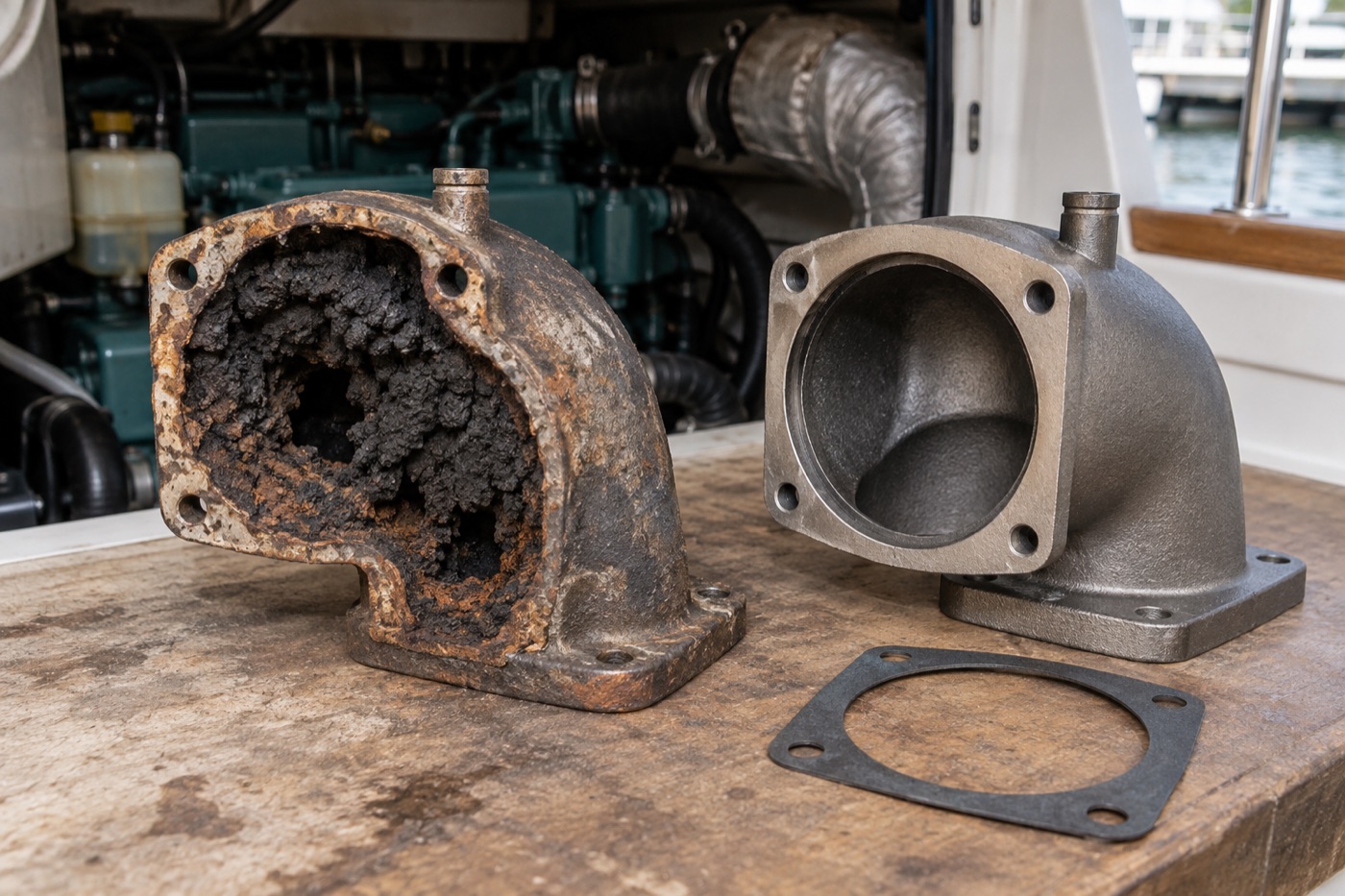
The exhaust elbow — also called the mixing elbow or riser — is where seawater is injected into hot exhaust gas to cool it. It sits in the worst environment on the engine, and every one of them eventually blocks with carbon or corrodes through.
It is a consumable part. The trouble is that its failure mode is not a consumable’s.
Is it safe to keep going?
Not for long, and not at all if water is reaching the cylinders.
A restricted elbow raises exhaust back pressure, which overheats the engine, overloads the turbo and costs power. A corroded one lets seawater into the exhaust passage — and from there past an open valve into a cylinder. That hydrolocks the engine, and cranking a hydrolocked engine bends connecting rods.
If the engine is hard to turn or will not start after sitting, do not keep cranking it.
Symptoms
| Symptom | What it indicates |
|---|---|
| Loss of power at the top end | Restriction building |
| Running hotter under load | Back pressure |
| Black smoke, soot on the transom | Restricted exhaust |
| Louder or changed exhaust note | Partial blockage |
| Rust staining or weeping at the flange | Corrosion through the casting |
| Hard starting after the boat has sat | Water entering a cylinder |
| Engine will not turn by hand | Hydrolock — stop |
Why it happens
Carbon builds where hot dry gas meets injected water, progressively narrowing the bore. Meanwhile salt water attacks the casting from the water-jacket side. The two processes run in parallel, and neither is visible from outside.
A restriction of half the bore causes real symptoms and cannot be seen without removing the elbow.
Inspection is the whole answer
An elbow is inexpensive to replace and ruinously expensive to ignore. Inspection means taking it off and looking inside — not tapping it and forming a view.
Most engine makers specify an inspection interval for this component. Very few owners know it exists. If your engine is more than a few years old and the elbow has never been off, that is the highest-value inspection available to you.
Exhaust elbow and riser replacement
What you can check yourself
Look for rust staining, weeping or salt crystals around the flange and the water injection point. Note any change in exhaust note or a drop in top-end revs. Beyond that, this needs the part removed, and seized studs make that a job worth paying for.
When to call a mechanic
At the inspection interval, or on any of the symptoms above. Immediately if the engine is hard to turn, hard to start after sitting, or if you find water where it should not be.
Ask them to check the installation geometry as well as the part — riser height and exhaust loop determine whether water can run back to the engine at rest. If your engine has ingested water once, replacing the elbow without checking geometry invites it to happen again.
What diagnosis costs
The part is usually modest. The labour depends entirely on whether the studs come out or shear.
Common on these engines
Elbow corrosion is a well-known item on older Volvo Penta and Yanmar installations, and on any engine in warm tropical water where corrosion runs faster.
→ Volvo Penta: blocked exhaust elbow · Yanmar: blocked exhaust elbow
Frequently asked questions
How often should the exhaust elbow be inspected? At the manufacturer’s interval. If it has never been removed and the engine is more than a few years old, do it now.
Can it be cleaned instead of replaced? Sometimes, if the casting is sound. But an elbow blocked enough to cause symptoms is usually corroded enough to be near the end of its life.
Is stainless better than cast iron? Stainless lasts longer here and many owners upgrade when replacing. Confirm the replacement matches the engine maker’s geometry requirements.
How does a bad elbow put water in my engine? Either by perforating so seawater enters the exhaust passage, or by restricting flow so water backs up instead of discharging. Both end at an open exhaust valve.
Practical summary
Use this fault guide safely
Stop now
Shut down for oil-pressure alarms, overheating, fuel spray, smoke in the engine space or loss of cooling-water flow.
Check safely
Start with visible leaks, strainers, fluid levels, alarms and loose connections—only when the machinery is safe and isolated.
Record evidence
Note rpm, temperature, smoke colour, alarm text, sea state and exactly when the symptom began.
Escalate
Give the evidence and engine model to a qualified marine mechanic; avoid repeated restart attempts.
Sources and verification
This page provides general Australian guidance. The current manual for the exact engine, gearbox or drive remains the authority for procedures, specifications and service intervals.
- 1Dry exhaust
- 2Mixing elbow
- 3Waterlock
- 4Hose rise
- 5Hull outlet