
On this page
Independent engine comparison
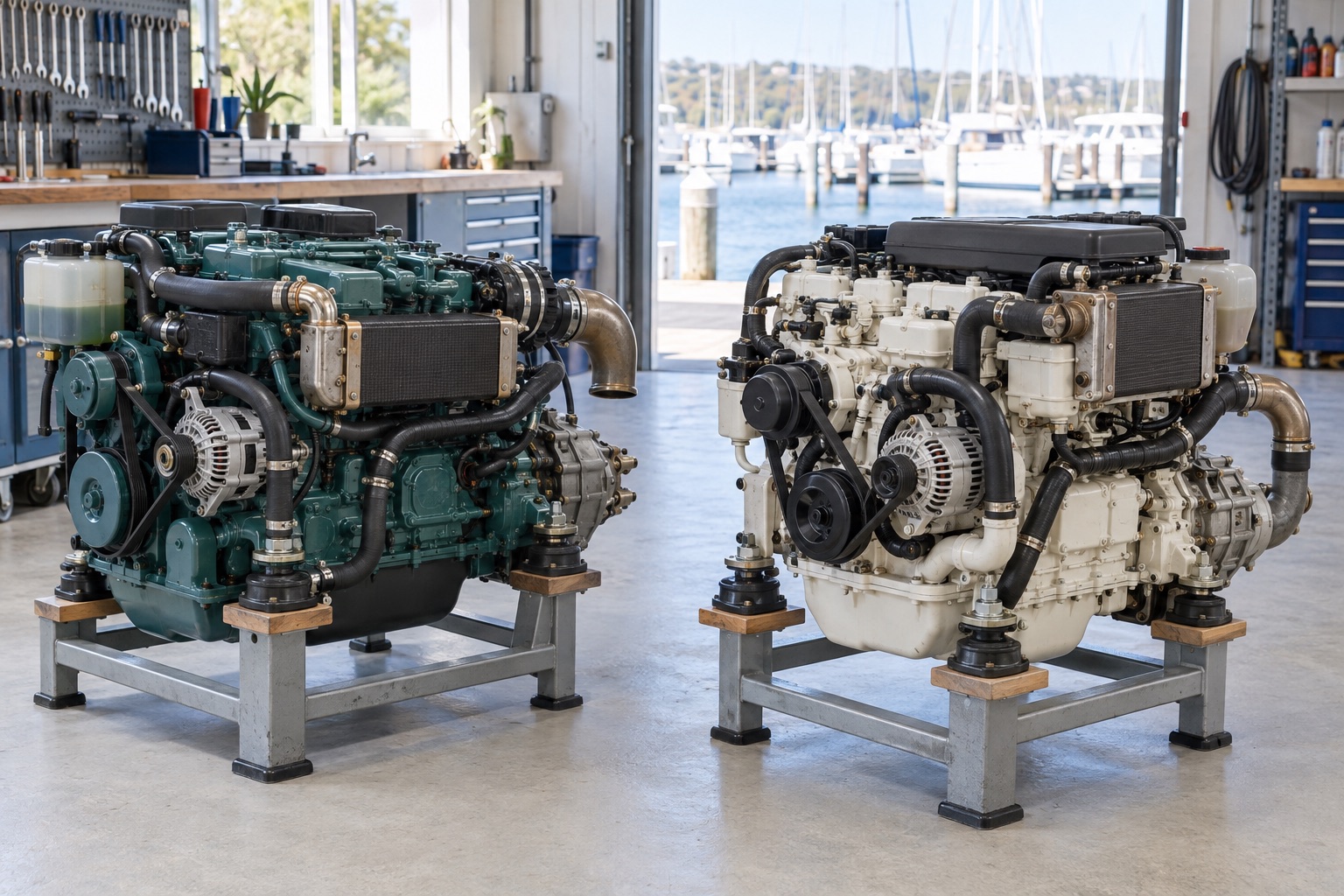
Yanmar Marine Engine vs Nanni Marine Engine
Sailing yachts, displacement cruisers and compact powerboat repowers. This guide compares real selection and ownership factors for Australian boats rather than declaring a winner from headline horsepower.
Where this marine engine comparison is valid
Comparing exact models in the same output and duty class with a defined shaft, saildrive or other driveline.
Yanmar and Nanni overlap across several leisure and repower conversations, but each catalogue covers more than one engine size and installation type. A result based on brand reputation without model identification is not a usable repower decision.
Yanmar’s finder separates current and legacy engines. Nanni’s catalogue can be filtered by shaft line, saildrive, sterndrive, waterjet and surface drive and includes more than one base-engine relationship. This makes the configuration code and drawing central evidence.
Representative model matchup
Yanmar 4JH45 vs Nanni N4.50 Marine Engine
A naturally aspirated four-cylinder comparison around 45–48 hp. Displacement and dry mass are close, but injection system, rated speed and controls differ.
On a phone, swipe across the table to compare both model specifications.
| Published specification | Yanmar 4JH45 | Nanni N4.50 |
|---|---|---|
| Rated output | 33.1 kW / 45 mhp | 35.4 kW / 47.5 hp |
| Rated speed | 3,000 rpm | 2,800 rpm |
| Cylinder layout | 4 in-line | 4 in-line |
| Displacement | 2.190 L | 2.197 L |
| Published dry weight | 220 kg without gear | 216 kg dry |
| Rating or duty context | ISO 8665 crankshaft output | Nanni M4 |
| Driveline context | Multiple shaft gears or SD60 saildrive | Shaft line or saildrive |
What the numbers mean: Physical mass and displacement are similar, but the Yanmar uses common-rail direct injection while the Nanni sheet lists mechanical indirect injection. That affects controls, diagnostics and installation—not simply output.
Specification boundary: Manufacturer data can change by market, emissions build, gear, cooling system and option package. Values above are a shortlisting snapshot, not installation approval. Obtain the current Australian datasheet and dimensioned drawing identified by model and specification revision.
Key marine engine differences
On a phone, swipe across the table to compare both marine engine options.
| Decision factor | Yanmar | Nanni |
|---|---|---|
| Range navigation | Use application, power, speed and certification filters, then identify whether the engine is current or legacy. | Use power, application, drive and certification filters, then confirm the base-engine and marine model. |
| Driveline | Match the exact marine gear or Yanmar saildrive generation and ratio. | Match the offered shaft gear, saildrive or other supported configuration and ratio. |
| Controls | Confirm whether the candidate is mechanical or electronic and price the matching panel and loom. | Confirm the model’s control type, panel, harness and display integration. |
| Parts record | Keep engine and drive serials together. | Keep Nanni marine model, base-engine identity and gearbox or drive serials together. |
For both candidates, also compare current model and legacy replacement path; base-engine and marinisation identities; drive options, controls and electrical integration; local stock, technician access and warranty party. Never treat a higher intermittent or recreational output as equivalent to a lower continuous or commercial rating without reading the manufacturer’s rating definition.
Maintenance and ownership in Australia
Catalogue breadth can create parts-ordering mistakes. Record the full model suffix and serial range, not only the large badge on the cover. Marine cooling, exhaust, mounts and electrical components may not cross between models that share a similar long motor.
Ask who will commission the installation, who can access model-specific diagnostics, where routine parts are physically stocked and what the plan is if the boat operates outside a capital city. “Available in Australia” is not the same as a part being available near the vessel when it is immobilised.
Keep the engine model, serial number, gearbox or drive identity, control generation and specification sheet together in the vessel record. This prevents future parts orders from being based on appearance or a boat builder’s brochure.
Comparing used marine engines
A used engine is a condition-and-installation purchase, not a brand vote. Hours without load history, calendar age, cooling maintenance and oil evidence say little. Inspect the cold engine and retain photographs and readings from the trial.
- Record both marine-model and base-engine identification plates
- Compare cold start, exhaust-water flow, charging and loaded maximum rpm
- Inspect exhaust elbow, mounts, seawater pump, heat exchanger and gearbox history
- Confirm the installed propeller, ratio and shaft line suit the exact engine rating
For a high-value purchase, arrange an independent inspection and consider oil analysis, cooling-system pressure testing and electronic history where supported. Read the pre-purchase engine checklistand sea-trial evidence guide.
Marine engine quote checklist
Give both suppliers the same vessel data and require these items in writing:
- Dimensioned drawing with mount centres, shaft height and service clearances
- Engine, gearbox or saildrive, ratio, panel, loom, mounts and alternator schedule
- Cooling, exhaust, fuel, electrical and propeller changes stated
- Commissioning, sea trial, warranty registration and Australian warranty party
- Removal, installation, freight, haul-out, fluids, exclusions and tax
- Commissioning values, sea-trial acceptance criteria and warranty party
Compare the installed total, not an engine crate against a complete package. Use the repower measurement guideand comparable engine quote guide.
Which marine engine should you choose?
Decision rule: Do not compare the brands as single ranges. Select two exact configurations, then compare their drawings, driveline, supplied accessories and local support line by line.
Score the two exact proposals against non-negotiables first: correct duty, physical fit, driveline compatibility, safe service access and credible commissioning. Only then compare price, noise, controls and preferences. If either supplier cannot document the rating or installation, the proposal is not ready to compare.
Frequently asked questions
Which is better: Yanmar or Nanni?
Neither brand wins every installation. Compare exact models with equivalent duty ratings, then choose the complete package that fits the vessel, driveline, operating profile and available Australian support.
Can I replace Yanmar with Nanni?
Potentially, but it is not a like-for-like swap until mounts, shaft height, gearbox or drive, controls, exhaust, cooling, electrical system, service clearance, propeller match and removal path have been checked.
What should an engine comparison quote include?
It should name the exact engine model, output, rpm and duty rating plus the gearbox or drive, controls, mounts, cooling and exhaust changes, installation labour, propeller work, commissioning, sea trial, warranty party and exclusions.
Are the model families in this guide all sold new in Australia?
Not necessarily. Australian boats contain current and legacy engines. Confirm current supply, specification, certification, warranty and dealer support with the manufacturer or authorised Australian distributor.
Are Yanmar 4JH45 and Nanni N4.50 direct replacements?
No model should be treated as a direct replacement from a specification table alone. Verify duty approval, dimensions, mounts, shaft height, gearbox or drive, propeller match, cooling, exhaust, controls, electrical system, service clearances and the complete installed mass.
More marine engine comparisons
Practical summary
Make the comparison decision-ready
Compare like with like
Align duty rating, output, driveline, emissions basis and included equipment.
Verify fit
Check dimensions, mounts, shaft height, cooling, exhaust, ventilation and service access.
Price installed
Include controls, gearbox or drive, propeller work, labour, commissioning and haul-out.
Choose support
Name the Australian warranty party, commissioning technician and parts route before ordering.
- 1Engine envelope
- 2Mount centres
- 3Shaft height
- 4Service zones
- 5Removal path