
On this page
Independent engine comparison
Cummins Marine Engine vs Caterpillar Marine Engine
Planing craft, sportfishing boats and commercial vessels. This guide compares real selection and ownership factors for Australian boats rather than declaring a winner from headline horsepower.
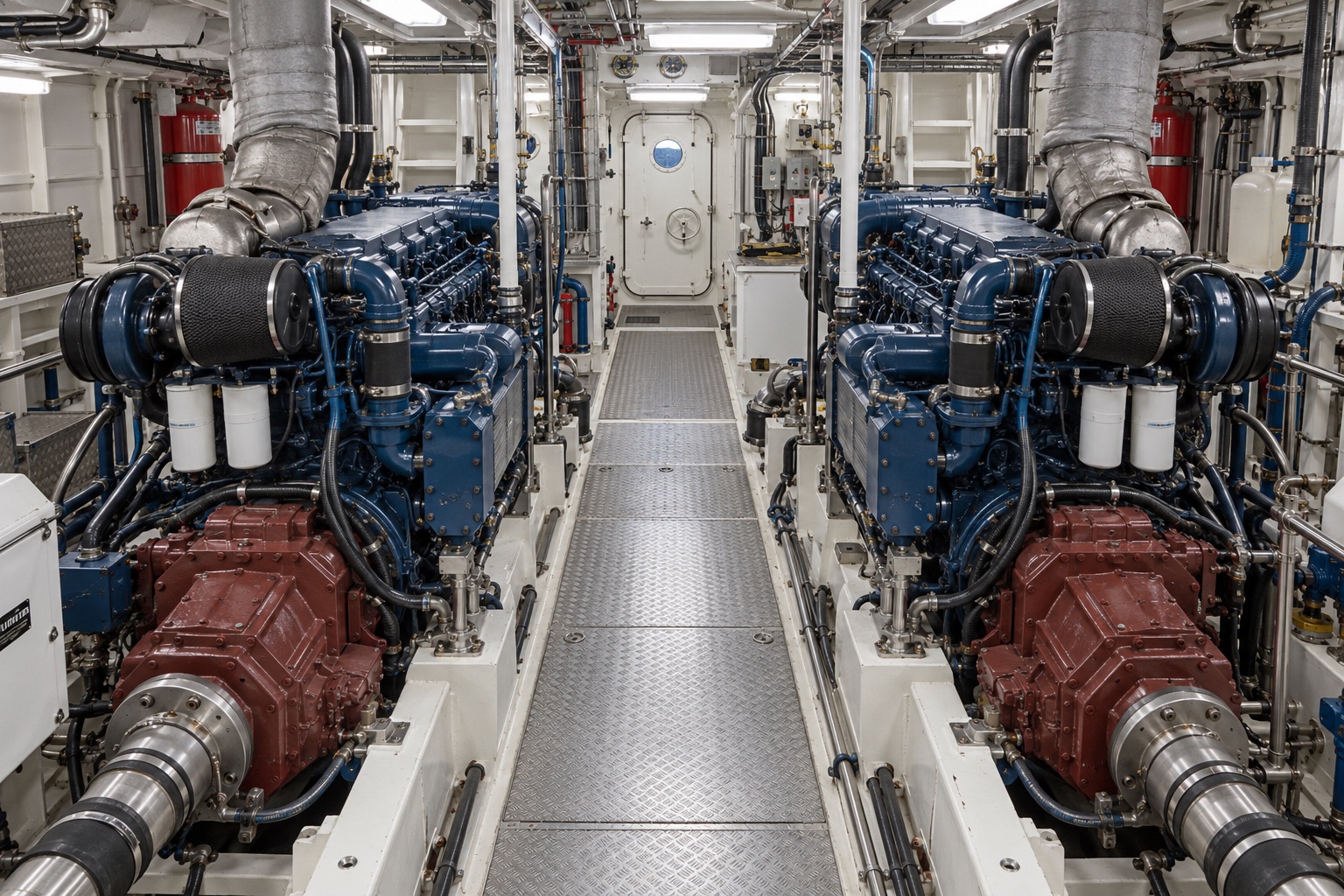
Where this marine engine comparison is valid
Comparing models with equivalent duty ratings, emissions requirements and realistic loaded-vessel performance.
Cummins versus Caterpillar becomes a real comparison on planing motor yachts, sportfishing boats and commercial craft only after the duty category is aligned. Both manufacturers publish multiple marine applications and ratings. A recreational high-output engine and a commercial propulsion engine can share similar displacement yet be approved for very different annual hours and load factors.
Cummins’ marine QSB material distinguishes variable-speed propulsion ratings and application classes. Caterpillar separates commercial propulsion from high-performance propulsion and publishes configuration details such as cooling options on model pages. Use those manufacturer definitions—not a sales listing’s horsepower field—as the starting evidence.
Representative model matchup
Cummins QSB6.7 425 vs Caterpillar C9.3 416 Marine Engine
A deliberately power-adjacent comparison that demonstrates why matching horsepower alone is unsafe: the Cummins high-output rating and Cat C commercial rating are not the same duty proposition.
On a phone, swipe across the table to compare both model specifications.
| Published specification | Cummins QSB6.7 425 | Cat C9.3 416 |
|---|---|---|
| Rated output | 312 kW / 425 mhp | 310 bkW / 416 bhp |
| Rated speed | 3,000 rpm | 2,100 rpm |
| Cylinder layout | 6 in-line | 6 in-line |
| Displacement | 6.7 L | 9.3 L |
| Published dry weight | 658 kg | 1,122 kg approximate |
| Rating or duty context | High Output | C rating |
| Driveline context | Conventional marine gear selected separately | Commercial marine gear selected separately |
What the numbers mean: Outputs are close, but rated speed, displacement, mass and duty category are materially different. Only compare them after the vessel mission and permitted full-load exposure are documented.
Specification boundary: Manufacturer data can change by market, emissions build, gear, cooling system and option package. Values above are a shortlisting snapshot, not installation approval. Obtain the current Australian datasheet and dimensioned drawing identified by model and specification revision.
Key marine engine differences
On a phone, swipe across the table to compare both marine engine options.
| Decision factor | Cummins Marine | Caterpillar Marine |
|---|---|---|
| Rating evidence | Record the exact rating name, rated rpm, emissions certification and application restrictions. | Record commercial or high-performance category, rating letter or definition, rpm and emissions configuration. |
| Cooling and air | Confirm heat-exchanger arrangement, aftercooler circuit, seawater plumbing and engine-room air demand. | Confirm heat-exchanger or keel-cooling option, aftercooler circuit, exhaust option and ventilation requirement. |
| Controls | Check ECM generation, display, harness, sensors and access to marine diagnostic tooling. | Check ECM and display generation, event history, monitoring integration and authorised diagnostic access. |
| Loaded performance | Proposal must include gearbox ratio and propeller calculation for the loaded vessel. | Proposal must include matching rating, gear ratio, propeller calculation and commissioning data. |
For both candidates, also compare duty rating, annual hours, load factor and permitted time at rated power; dry or wet exhaust, cooling configuration and auxiliary-drive needs; electronic diagnostics, trend data and technician access; gearbox rating, propeller calculation and loaded maximum rpm. Never treat a higher intermittent or recreational output as equivalent to a lower continuous or commercial rating without reading the manufacturer’s rating definition.
Maintenance and ownership in Australia
Aftercooler condition, seawater-side maintenance, fuel cleanliness and correct loading are major evidence points on either brand. On a twin-engine boat, compare both engines’ data rather than accepting that similar hours mean similar condition. A persistent rpm, temperature or fuel-rate difference can expose propeller, cooling or engine issues.
Ask who will commission the installation, who can access model-specific diagnostics, where routine parts are physically stocked and what the plan is if the boat operates outside a capital city. “Available in Australia” is not the same as a part being available near the vessel when it is immobilised.
Keep the engine model, serial number, gearbox or drive identity, control generation and specification sheet together in the vessel record. This prevents future parts orders from being based on appearance or a boat builder’s brochure.
Comparing used marine engines
A used engine is a condition-and-installation purchase, not a brand vote. Hours without load history, calendar age, cooling maintenance and oil evidence say little. Inspect the cold engine and retain photographs and readings from the trial.
- Obtain ECM hours by load band and fault history where available
- Inspect aftercooler and heat-exchanger service evidence, not only invoices labelled annual service
- Confirm both engines reach the specified loaded rpm with normal fuel, water and cruising load
- Sample engine and gearbox oils and record coolant condition before purchase
For a high-value purchase, arrange an independent inspection and consider oil analysis, cooling-system pressure testing and electronic history where supported. Read the pre-purchase engine checklistand sea-trial evidence guide.
Marine engine quote checklist
Give both suppliers the same vessel data and require these items in writing:
- Exact model, power, rpm, duty rating and emissions configuration
- Gearbox model, ratio, controls and display package
- Cooling, exhaust, fuel-return and ventilation engineering
- Commissioning report with loaded rpm, temperatures, pressures and warranty registration
- Removal, installation, freight, haul-out, fluids, exclusions and tax
- Commissioning values, sea-trial acceptance criteria and warranty party
Compare the installed total, not an engine crate against a complete package. Use the repower measurement guideand comparable engine quote guide.
Which marine engine should you choose?
Decision rule: Do not compare a high-output recreational rating with a lower-output commercial rating as if horsepower were the only difference. Match the operating profile first.
Score the two exact proposals against non-negotiables first: correct duty, physical fit, driveline compatibility, safe service access and credible commissioning. Only then compare price, noise, controls and preferences. If either supplier cannot document the rating or installation, the proposal is not ready to compare.
Frequently asked questions
Which is better: Cummins Marine or Caterpillar Marine?
Neither brand wins every installation. Compare exact models with equivalent duty ratings, then choose the complete package that fits the vessel, driveline, operating profile and available Australian support.
Can I replace Cummins Marine with Caterpillar Marine?
Potentially, but it is not a like-for-like swap until mounts, shaft height, gearbox or drive, controls, exhaust, cooling, electrical system, service clearance, propeller match and removal path have been checked.
What should an engine comparison quote include?
It should name the exact engine model, output, rpm and duty rating plus the gearbox or drive, controls, mounts, cooling and exhaust changes, installation labour, propeller work, commissioning, sea trial, warranty party and exclusions.
Are the model families in this guide all sold new in Australia?
Not necessarily. Australian boats contain current and legacy engines. Confirm current supply, specification, certification, warranty and dealer support with the manufacturer or authorised Australian distributor.
Are Cummins QSB6.7 425 and Cat C9.3 416 direct replacements?
No model should be treated as a direct replacement from a specification table alone. Verify duty approval, dimensions, mounts, shaft height, gearbox or drive, propeller match, cooling, exhaust, controls, electrical system, service clearances and the complete installed mass.
More marine engine comparisons
Practical summary
Make the comparison decision-ready
Compare like with like
Align duty rating, output, driveline, emissions basis and included equipment.
Verify fit
Check dimensions, mounts, shaft height, cooling, exhaust, ventilation and service access.
Price installed
Include controls, gearbox or drive, propeller work, labour, commissioning and haul-out.
Choose support
Name the Australian warranty party, commissioning technician and parts route before ordering.
- 1Engine envelope
- 2Mount centres
- 3Shaft height
- 4Service zones
- 5Removal path