
On this page
Shaft Drive vs Sterndrive vs IPS
Three ways of getting power from a diesel to the water, with genuinely different maintenance profiles. If you are choosing a boat, this affects what you will be paying a mechanic for over the next decade.
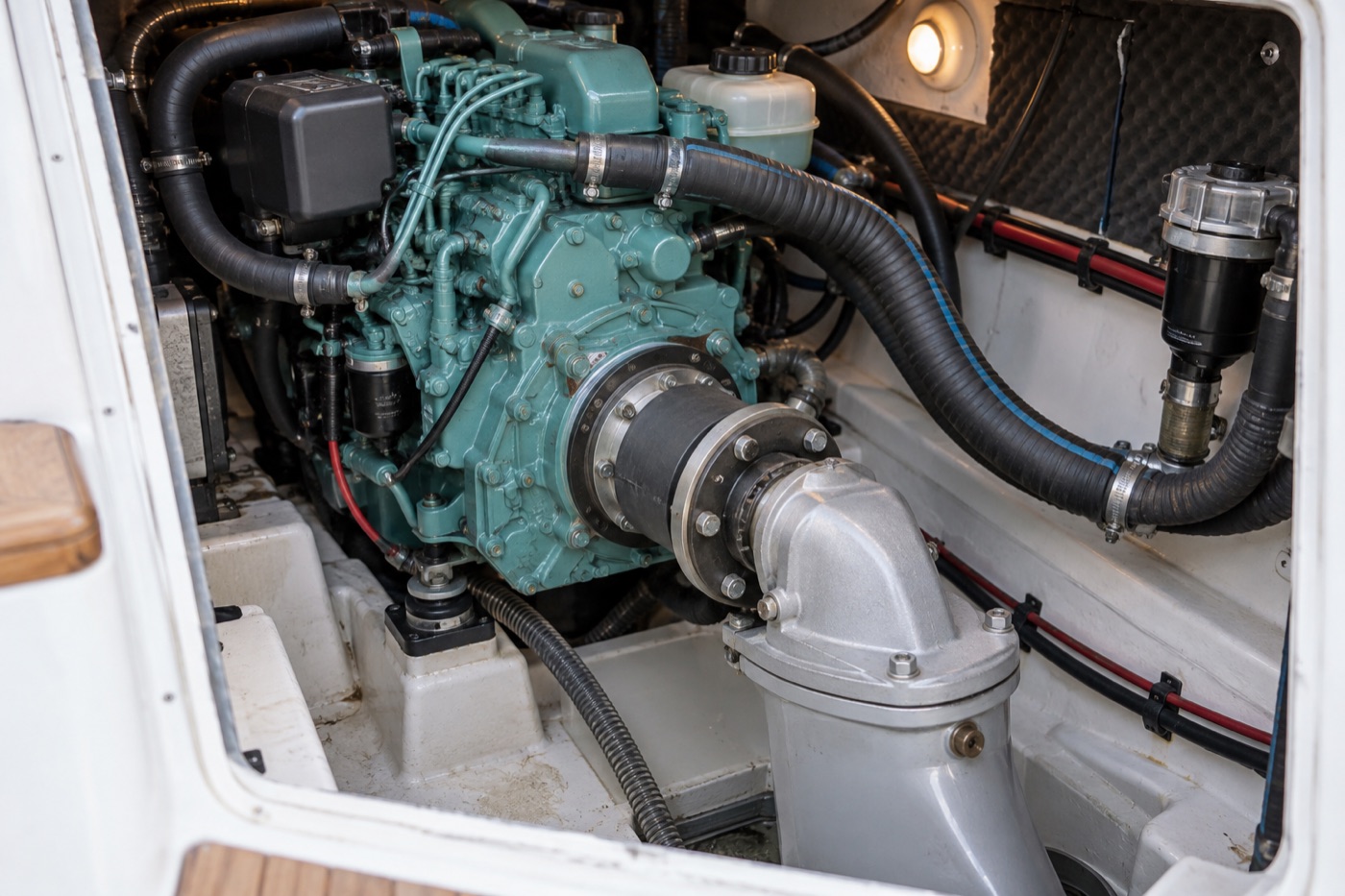
Shaft drive
The engine drives a straight shaft angled down through the hull to a propeller ahead of the rudder.
Strengths. Mechanically simple. Nothing steerable below the waterline. Robust to grounding in the sense that damage is usually to shaft, prop or strut rather than to the drive. Parts are generic and widely available. Servicing can be done by any competent marine mechanic anywhere.
Costs. Thrust is angled, so some of it pushes down rather than forward. Manoeuvring at low speed is harder without thrusters. The stern gland and cutless bearing are maintenance items. Alignment must be checked periodically.
Maintenance profile. Low, predictable, cheap parts, widely serviceable.
Sterndrive
An inboard engine drives a steerable leg through the transom.
Strengths. Good manoeuvrability. Trimmable, which helps planing hulls across a range of speeds and loads. Engine sits aft, freeing interior space. The leg can usually be raised for shallow water or trailering.
Costs. A complex leg with bellows, gimbal bearings, universal joints, seals and steering components, all below or at the waterline. Bellows are a time-based replacement item and a failure floods the boat. Anodes are consumed fast. Salt water is hard on the assembly, and permanently moored boats suffer more than trailered ones.
Maintenance profile. Highest routine attention of the three, and the consequences of skipping it are severe.
IPS and pod drives
Forward-facing pods mounted through the hull, steering by rotating.
Strengths. Very efficient — forward-facing propellers work in undisturbed water and thrust is horizontal. Excellent low-speed handling with joystick control. Quiet, with less vibration into the hull.
Costs. Proprietary. Servicing requires a dealer or a trained technician with the manufacturer’s tools, which limits where you can get work done in Australia outside the major centres. Haul-out is required for leg service. Parts are not generic. A significant grounding is expensive, though the systems are designed to shear in a way that protects the hull.
Maintenance profile. Manufacturer-scheduled, dealer-dependent, higher cost per event but well-defined.
Choosing between them
| If you value | Consider |
|---|---|
| Simplicity and servicing anywhere | Shaft |
| Long-range and offshore reliability | Shaft |
| Manoeuvring in tight marinas | IPS, or sterndrive |
| Fuel efficiency at cruise | IPS |
| Trailering and shallow water | Sterndrive |
| Lowest routine maintenance cost | Shaft |
| Remote-area cruising | Shaft |
The remote-cruising point matters more in Australia than in most markets. If your plans include the Kimberley, the Gulf, or long stretches of the Queensland coast, the ability to have work done by any local mechanic is a real consideration.
What to check when buying
- Shaft: stern gland condition, cutless bearing play, alignment records, shaft straightness.
- Sterndrive: bellows age and condition, gimbal bearing, leg oil condition, anode wastage, corrosion around the transom shield.
- IPS/pod: service history against manufacturer schedule, leg oil, seal condition, and whether the seller has the diagnostic records.
Frequently asked questions
Which drive type is cheapest to maintain? Shaft drive, generally — fewest wear items below the waterline and generic parts.
How often do sterndrive bellows need replacing? The manufacturer specifies an interval in years. Treat unknown history as overdue: a bellows failure sinks boats.
Are pod drives reliable? Modern pod systems are reliable when serviced to schedule. The constraint is where you can get that servicing done, not whether they work.
Can I convert from one drive type to another? Technically possible and very rarely economic. It involves engine position, beds, hull penetrations and often the exhaust.
Which is best for offshore cruising? Shaft, for most people — simplicity, robustness and the ability to get parts and service anywhere.
Practical summary
Make the comparison decision-ready
Compare like with like
Align duty rating, output, driveline, emissions basis and included equipment.
Verify fit
Check dimensions, mounts, shaft height, cooling, exhaust, ventilation and service access.
Price installed
Include controls, gearbox or drive, propeller work, labour, commissioning and haul-out.
Choose support
Name the Australian warranty party, commissioning technician and parts route before ordering.
Sources and verification
This page provides general Australian guidance. The current manual for the exact engine, gearbox or drive remains the authority for procedures, specifications and service intervals.
- 1Flywheel
- 2Marine gear
- 3Coupling
- 4Shaft & bearings
- 5Propeller